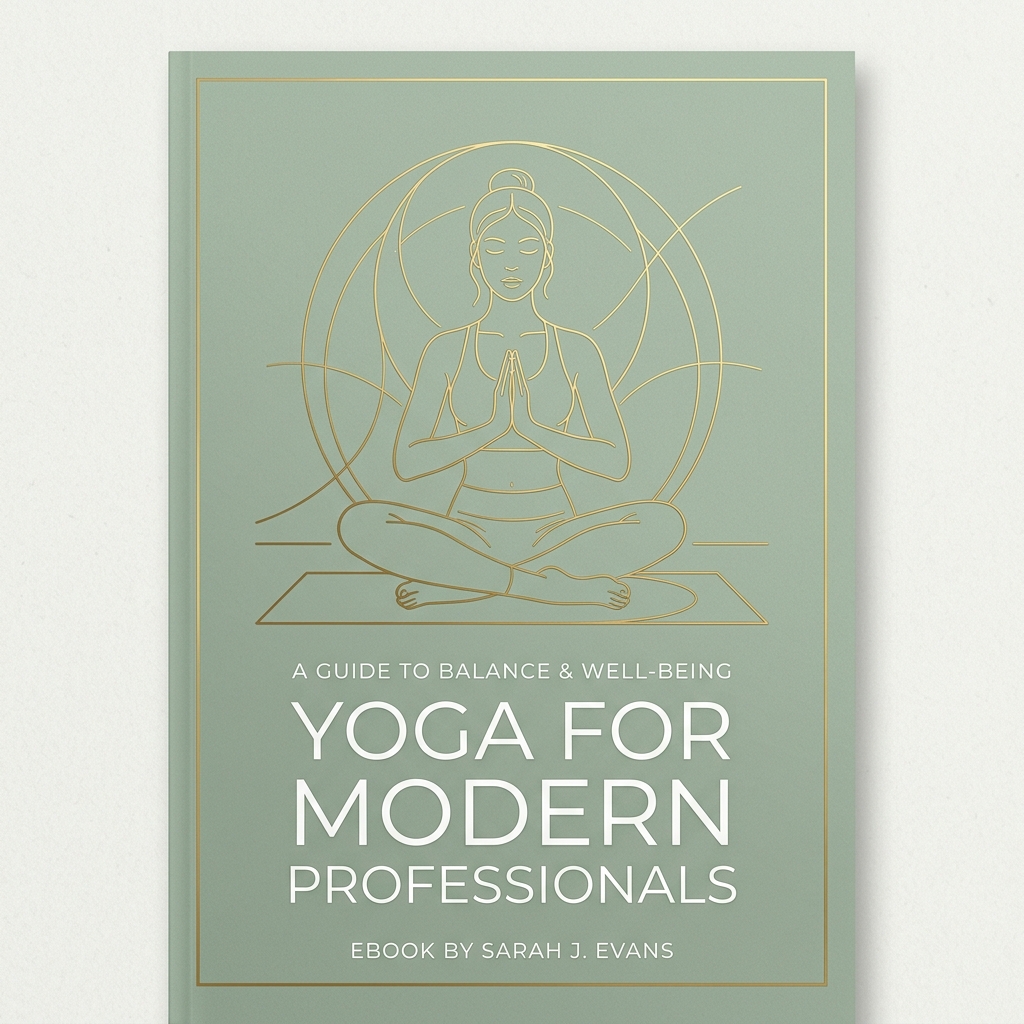
Yoga for Modern Professionals
A Premium Guide to De-Stress, Align, and Energize Your Work Life
Dedication & legal Notice
"To everyone sitting in a chair dreaming of movement, focus, and breathing space. May this guide be your doorway back to the body."
Medical Disclaimer
The information in this book is for educational purposes only. Consult a physician before beginning any exercise or yoga program, especially if you have pre-existing spinal, joint, or cardiovascular conditions. The exercises described herein should not cause pain. If you experience pain or discomfort, stop immediately and seek medical attention.
Index of Chapters
Why Yoga? Why Now?
We are living through a massive evolutionary mismatch. Our bodies were designed to walk, stretch, crouch, and run across vast savannahs. Instead, we spend our lives folded into office chairs, staring at pixels.
This mismatch has led to a silent crisis of vitality. We accept neck pain, back strain, and mid-afternoon brain fog as normal costs of doing business. But they are not normal. They are signals from a body starved of natural movement, deep oxygenation, and neurological stillness.
Yoga offers an ancient, time-tested system to counteract these symptoms. You do not need to quit your job or retreat to an ashram. By implementing small, intentional physical actions into your workspace, you can completely reset your physical and mental alignment.
The Modern Dilemma: Somatic Wear & Tear
For eight to twelve hours a day, the human body is frozen in front of glowing displays. We sit, shoulders hunched, chest collapsed, neck strained forward, typing away while our nervous system absorbs a steady drip of micro-stressors.
Modern workplace culture has separated the mind from the body. We treat our physical selves as mere vehicles for carrying our brains from meeting to meeting. The consequences of this dissociation are chronic physical discomfort, shallow breathing, and mental exhaustion.
1.1 The Anatomy of Desk Sitting
When you sit for prolonged periods, several muscular imbalances occur automatically. Sitting places the spine in a flexed shape, which changes the natural curves of the neck and back.
As the pelvis tucks under, the lower back rounds. This places extra pressure on your spinal discs, which can lead to bulging or chronic aches. Over time, your body adapts to this shape, shortening muscles that should be long, and weakening muscles that should be strong.
In this chapter, we explore how sitting changes your muscle length, your bone alignment, and your breathing patterns.
1.2 What Sitting Does to Your Psoas
The psoas muscle is the main hip flexor connecting your lower spine to your thigh bones. When you sit, your knees are bent and your psoas is kept in a shortened state.
If you sit for 8 hours, the psoas adapts by tightening. When you finally stand up, the tight psoas pulls on your lower spine, causing an excessive arch in your lower back. This condition, known as anterior pelvic tilt, is the primary source of lower back pain for desk workers.
Regularly stretching the hip flexors resets pelvis alignment and relieves lower spine pressure.
1.3 The Chest & Shoulder Collapse
Gravity constantly pulls your torso forward as you type. Without conscious attention, the shoulders roll forward, and the head slides forward over the collarbone.
This forward posture tightens the pectoralis minor muscles in your chest. At the same time, the muscles in your upper back (rhomboids and traps) are pulled tight and weakened, causing chronic neck aches and shoulder tension.
This collapse also reduces the space in your chest cavity, making deep breathing physically difficult.
1.4 Shallow Breathing & Nervous System Tension
A collapsed posture compresses your abdomen and diaphragm, restricting your lungs' ability to expand downward. As a result, you rely on shallow chest breathing.
Shallow breathing triggers the sympathetic nervous system, signaling to your brain that you are under stress. This keeps you in a low-grade state of fight-or-flight, elevating cortisol, heart rate, and anxiety.
Conscious breathing exercises act as a physical switch, immediately signaling safety to the brain and restoring calm.
Peak Breathwork (Pranayama)
The quickest way to change your state of mind is to change your breath. By controlling your respiratory rate, you directly modulate your autonomic nervous system.

Pranayama is the ancient science of breath control. In this chapter, we cover four targeted breathing exercises designed to help you de-stress, focus, and recharge during your workday.
Box Breathing (Samavritti)
Used by high-performers to restore calm and cognitive focus under high pressure.
Alternate Nostril Breathing (Nadi Shodhana)
An ancient practice to balance the left and right hemispheres of the brain, reducing anxiety.

Diaphragmatic Belly Breathing
Directly targets and expands the diaphragm to reverse shallow, stress-inducing chest breathing.

Humming Bee Breath (Bhramari)
Creates a soothing vibration in your throat and head that stimulates the vagus nerve for instant anxiety reduction.

The 10 Essential Poses for Desk Dwellers
You do not need a yoga mat or special clothing to release physical stiffness. These poses focus on structural restoration and can be done anywhere.

On the following pages, you will find 10 targeted postures designed to release tension in your neck, shoulders, spine, and hips. Perform them daily for best results.
Seated Cat-Cow (Marjaryasana-Bitilasana)
Focus: Spine mobility & chest opening.
Sit tall near the edge of your chair with feet flat on the floor. Place your hands on your knees. Inhale, arch your back, draw your shoulder blades together, and look up, opening your chest (Cow). Exhale, round your spine, tuck your chin to your chest, and pull your navel toward your spine (Cat). Repeat slowly 10 times, matching your breath to the movement.

Chest Opener (Baddha Hasta Variant)
Focus: Reversing shoulder roll & expansion.
Sit or stand tall. Interlace your fingers behind your back, keeping your knuckles pointing down. Roll your shoulders back and down. Gently straighten your arms and lift your hands away from your lower back while lifting your chest toward the ceiling. Keep your collarbone wide and hold for 5 slow, deep breaths, feeling your chest open.

Seated Spinal Twist (Ardha Matsyendrasana)
Focus: Relieving lower back compression.
Sit sideways on your chair, facing right, with your feet flat on the floor. Hold the back of your chair with both hands. Inhale deeply, extending your spine upward. As you exhale, gently twist your torso to the right, looking over your right shoulder. Hold for 5 breaths. Release slowly, turn to face the left, and repeat on the other side.

Downward-Facing Dog (Adho Mukha Svanasana)
Focus: Hamstrings, shoulders, and spine length.
Stand facing the back of your chair or a desk. Place hands on it shoulder-width apart. Walk your feet back until your torso is parallel to the floor, forming an L-shape. Press your hips back away from your hands, allowing your chest to melt toward the floor. Keep knees slightly bent to protect the lower back, and hold for 8 deep breaths.

Sphinx Pose (Salamba Bhujangasana)
Focus: Upper back extension & posture correction.
Lie face down on the floor (or lean forward resting elbows on your desk). Place your elbows directly under your shoulders, forearms flat and parallel. Press your palms and forearms firmly down. Inhale, lift your chest, and pull your shoulders back away from your ears, extending your spine. Hold for 8 slow, deep breaths.

Eagle Arms (Garudasana Arms)
Focus: Releasing tension between shoulder blades.
Sit or stand tall. Extend your arms forward. Cross your right arm under your left, bend your elbows, and wrap your forearms, pressing your palms together (or the backs of your hands). Lift your elbows to shoulder height and press your hands away from your face. Breathe deeply into your upper back. Hold for 5 breaths, then repeat with left arm under right.

Standing Quad Stretch
Focus: Opening tight hip flexors and thighs.
Stand tall, holding your desk or a wall for balance. Bend your right knee, reach back, and clasp your right ankle with your right hand. Gently pull your heel toward your glutes, keeping knees aligned and hips pushed slightly forward. Hold for 5 breaths, then switch legs.

Cobra Pose (Bhujangasana)
Focus: Strengthening the lower back and opening the chest.
Lie face down on the floor. Place your palms flat under your shoulders, hugging your elbows close to your sides. Press the tops of your feet and your pelvis firmly down. Inhale, press into your hands, and lift your chest off the floor, keeping your shoulders relaxed. Hold for 5 slow breaths.

Seated Figure-4 (Chair Pigeon Pose)
Focus: Releasing tight glutes and hips.
Sit near the edge of your chair with feet flat. Cross your right ankle over your left knee. Flex your right foot to protect the joint. Inhale, extend your spine, and exhale to hinge forward from your hips, keeping your spine flat. Hold for 6 breaths, then switch sides.

Mountain Pose with Overhead Reach (Tadasana)
Focus: Resetting full-body posture and length.
Stand tall with feet hip-width apart. Root your feet firmly, engage your legs, and tuck your pelvis slightly. Inhale deeply, sweep your arms overhead, interlace your fingers, and flip your palms upward. Press down through your feet while reaching up with your hands. Hold for 5 slow, deep breaths.

Mindset & Daily Integration
The benefits of yoga do not end when you step away from the mat or finish your routine. The true challenge is maintaining presence throughout your workday.
Mindset integration is about converting your workspace from a site of stress to a sanctuary of somatic awareness. In this chapter, we outline key mindset shifts and daily habits.
4.1 The Habit Loop for Busy Schedules
To make yoga a lasting habit, you must attach it to existing triggers in your day. This is called the cue-routine-reward loop.
Instead of scheduling "yoga time," use daily work events as cues. For example:
- Cue: Standing up to go to a meeting. Routine: Roll shoulders back 3 times.
- Cue: Closing a browser tab. Routine: Take one diaphragmatic breath.
- Cue: Sitting down at your desk. Routine: Check seat alignment.
The reward is the immediate physical release of tension, which reinforces the habit loop.
4.2 Creating Physical Anchors & Triggers
Your physical environment can prompt mindful resets. Place small anchors near your workspace:
- Desktop Wallpaper: Use a simple, calming wallpaper with a reminder to "Breathe."
- Sticky Note: Put a note on your monitor with a symbol representing spine alignment.
- Phone Reminders: Set subtle, silent reminders to stand up or release your jaw.
4.3 Digital Boundaries & Soft Eyes
Staring at screens tightens your optic nerves and face muscles. Practice "soft eyes" by dilating your peripheral vision to reduce stress.
Additionally, set digital boundaries. Unsubscribe from unnecessary emails, turn off notifications during focus blocks, and step away from devices during breaks to restore mental clarity.
The 14-Day Transformation Plan
Consistency is more powerful than intensity. A daily 15-minute practice will produce far greater structural and mental improvements than a single 90-minute class once a week.
The following pages outline your daily schedules for Week 1 and Week 2. Commit to these blocks to build your new routine.
Week 1 Detail Schedule (Days 1 to 7)
| Day | Core Focus | Routine Components | Duration |
|---|---|---|---|
| Day 1 | Foundation | Box Breathing (3m) + Seated Cat-Cow & Chest Opener (10m) | 13 Mins |
| Day 2 | Spine Release | Diaphragmatic Breathing (3m) + Spinal Twist & Eagle Arms (10m) | 13 Mins |
| Day 3 | Alignment | Alternate Nostril Breath (4m) + Downward Dog & Quad Stretch (10m) | 14 Mins |
| Day 4 | Hip Release | Box Breathing (4m) + Seated Figure-4 & Sphinx Pose (10m) | 14 Mins |
| Day 5 | Cobra Opening | Bee Humming Breath (3m) + Cobra & Mountain Pose (10m) | 13 Mins |
| Day 6 | Total Flow | Box Breathing (5m) + Complete 4-Pose Desk Flow (10m) | 15 Mins |
| Day 7 | Recovery | Deep Diaphragmatic Breath + Legs resting on chair | 15 Mins |
Week 2 Detail Schedule (Days 8 to 14)
| Day | Core Focus | Routine Components | Duration |
|---|---|---|---|
| Day 8 | Nervous Calm | Alternate Nostril Breath (5m) + Seated Twists & Figure-4 (10m) | 15 Mins |
| Day 9 | Posture Strength | Box Breathing (5m) + Sphinx & Cobra Poses (10m) | 15 Mins |
| Day 10 | Lower Body | Diaphragmatic Breath (5m) + Quad Stretch & Downward Dog (10m) | 15 Mins |
| Day 11 | Upper Release | Humming Breath (5m) + Eagle Arms & Chest Opener (10m) | 15 Mins |
| Day 12 | Flow Fusion | Alternate Nostril Breath (5m) + Poses 1 to 5 Flow (10m) | 15 Mins |
| Day 13 | Peak Strength | Box Breathing (5m) + Poses 6 to 10 Flow (10m) | 15 Mins |
| Day 14 | Integration | Define your custom daily trigger routine & log progress | 15 Mins |
Workspace Ergonomics & Alignment
No amount of yoga can undo the stress of sitting if you return to a poorly calibrated workstation. Your physical environment must support your body's natural structure.
In this chapter, we outline detailed instructions to align your workstation, including monitor, chair, keyboard, and desk heights, to prevent chronic fatigue.
6.1 Calibrating Screen Height & Keyboard
Your screen height dictates your neck position. If your screen is too low, you bend your neck forward, multiplying the load on your spine (forward head posture).
Instructions: Position the top third of your monitor at eye level. Sit at your keyboard, relax your shoulders, bend your elbows at 90 degrees, and ensure your wrists remain straight while typing.
6.2 Seat Height, Pelvis Tilt & Footrests
Your pelvis is the foundation of your spine. If your pelvis tilts backward, your lower back rounds, pinching spinal discs.
Instructions: Adjust seat height so your hips are slightly higher than your knees. Keep your feet flat on the floor (or a footrest). Use lumbar support to maintain the natural curve of your lower back.
6.3 The 20-40-5 Rule for Standing Desks
Standing all day is not the solution—it strains your veins and joints. The key is movement.
The Rule: For every hour of work:
- 40 Minutes: Sit in an aligned posture.
- 20 Minutes: Stand at a calibrated desk height.
- 5 Minutes: Move, stretch, or walk.
Bonus: The 5-Minute Desk Flow
For days when emails are piling up and you cannot step away for a full routine, this rapid, discreet chair-based sequence acts as an emergency reset.
Use this quick flow to release physical tension and reset your nervous system in just five minutes.
The 5-Step Standing & Seated Flow
Daily Posture Checklist
Print this page and place it on your desk as a daily alignment reminder:
Closing Thoughts
Thank you for dedicating time to your well-being. Wellness is not a destination, but a daily practice of listening to your body and respecting its limits.
As you continue on this journey, remember that consistency is your greatest ally. Even five minutes of breathing or a single shoulder stretch during a busy workday can break the stress cycle, restore your posture, and clear your mind.
"Quiet the mind, and the soul will speak." — Ma Jaya Sati Bhagavati